
Is a VPN legal or illegal? This is one of the most searched questions in the privacy and cybersecurity space. The short answer is simple: VPNs are legal in most countries, including the United States, but become illegal only when used for unlawful activities or in countries where VPNs are banned.
This guide gives you a clear, updated and SEO‑optimized explanation of VPN legality worldwide, how laws work, the risks, and what you can safely do with a VPN.
Are VPNs Legal?
Yes. VPNs are legal in the US, UK, Canada, Europe, and most parts of the world. Using a VPN for privacy, security, streaming or online safety is legal as long as you are not performing illegal activities.
VPNs become illegal only when:
- You use them in a country where VPNs are banned.
- You use them to commit crimes (hacking, fraud, piracy).
Is It Legal to Use a VPN in the United States?
Using a VPN in the US is completely legal. In fact, cybersecurity experts and even law‑enforcement professionals recommend VPNs to protect online privacy.
Here is how US laws view VPN usage:
- Legal: Browsing privately, hiding your IP address, streaming, shopping online, protecting your data on public Wi‑Fi.
- Legal but may violate terms: Accessing Netflix libraries from other countries.
- Illegal: Using a VPN to hack, scam, or download copyrighted material (DMCA violation).
There is no US law banning VPNs, and platforms like Google, Amazon, banking sites and social networks allow VPN connections.
Where Are VPNs Legal Around the World?
VPNs are legal in the majority of countries. These include:
- United States
- United Kingdom
- Canada
- Australia
- Singapore
- Japan
- Germany
- France
- Italy
- Spain
- Brazil
- Mexico
- South Korea
In these countries, citizens can freely use VPNs for privacy, streaming and general online safety.
Countries Where VPNs Are Illegal or Heavily Restricted
A small number of countries ban or tightly regulate VPN usage. These countries have strict censorship laws and restrict citizens from viewing global content.
Countries Where VPNs Are Illegal:
- Belarus
- Iraq
- North Korea
- Turkmenistan
- Myanmar
Countries Where VPNs Are Restricted or Controlled:
- China (only government‑approved VPNs allowed)
- Russia (restricted, monitored)
- Iran (requires government approval)
- Turkey (VPN services often blocked)
- UAE (legal for most uses, illegal for VoIP bypassing)
- Oman (requires special permission)
- Egypt (many VPN services blocked)
- Uganda (VPNs regularly blocked)
- Venezuela (heavy censorship)
If you travel to these regions, it’s important to understand their laws before connecting to a VPN.
Legal vs Illegal VPN Activities
A VPN itself is legal. The activity may not be.
| Activity | Legal Status |
|---|---|
| Browsing privately | Legal |
| Hiding your IP | Legal |
| Streaming Netflix or Hulu | Legal, may violate ToS |
| Torrenting copyrighted files | Illegal |
| Hacking, phishing, cybercrime | Illegal |
| Accessing banned content in restricted countries | Illegal |
| Using VPN for banking, shopping, online security | Legal |
Is Using a VPN for Netflix or Streaming Illegal?
No. Using a VPN for Netflix, Disney+, Hulu or BBC iPlayer is legal. Streaming platforms may block VPNs or restrict content if they detect VPN usage, but it is not a crime.
The key difference:
- Legal: Accessing your paid services using a VPN.
- Not allowed by the platform: Accessing content not licensed in your region.
This can lead to content errors but not legal penalties.
What Happens If You Use a VPN in a Banned Country?
If you use a VPN in a country where it is illegal, consequences may include:
- Fines
- Device confiscation
- Detention or administrative penalties
- Deportation for foreign travellers
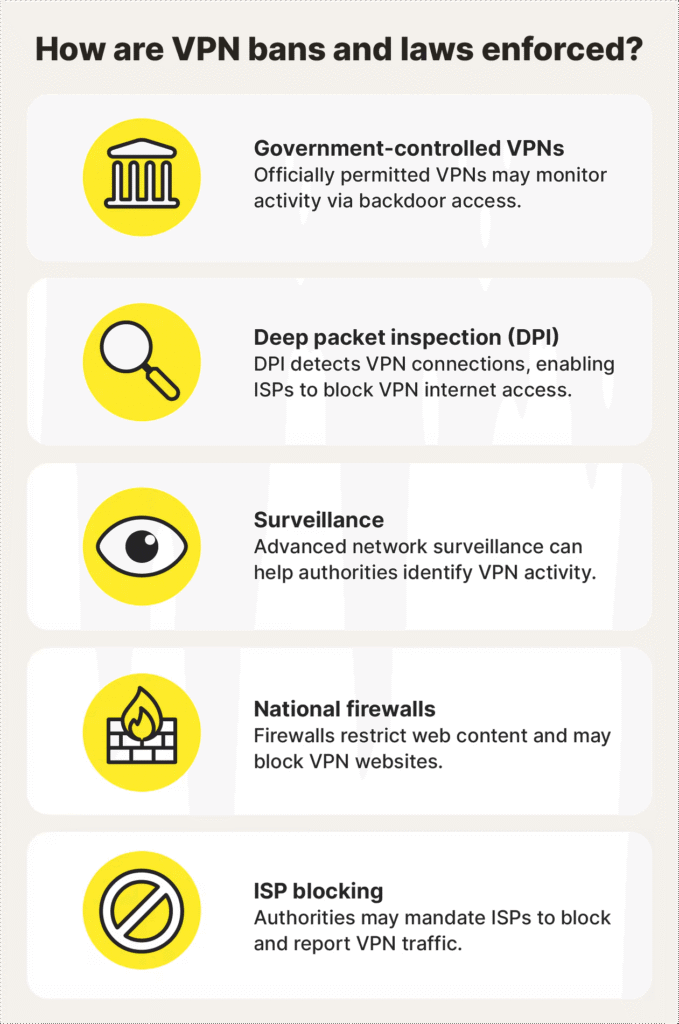
Countries like China and UAE enforce VPN restrictions through:
- ISP blocking
- Deep packet inspection
- Government‑approved VPN lists
- Heavy monitoring of online traffic
Always research local internet laws before connecting.
Source: norton.com
How Governments Detect VPN Use
Some governments use advanced detection methods to identify VPN traffic:
- Deep Packet Inspection (DPI): Identifies encrypted VPN patterns.
- Port Blocking: Blocks common VPN ports.
- IP Blacklists: Governments track IPs of known VPN servers.
- SNI Filtering: Identifies encrypted traffic going to known VPNs.
- National Firewalls: Blocks VPN websites or apps.
Modern premium VPNs use tools like obfuscation to disguise VPN traffic as normal HTTPS.
Is It Safe to Use a VPN?
Yes. VPNs improve safety by:
- Encrypting your internet traffic
- Protecting your identity on public Wi‑Fi
- Blocking ISP tracking
- Preventing data theft from hackers
- Reducing online profiling and ads
For maximum safety, choose a VPN that offers:
- No‑log policy
- AES‑256 encryption
- Kill switch
- DNS leak protection
- Independent security audits
How to Use a VPN Legally and Safely
To stay compliant with global laws:
- Avoid using VPNs in banned or restricted countries.
- Never use a VPN for illegal actions.
- Choose a no‑log, audited VPN provider.
- Use obfuscated servers only in high‑surveillance regions.
- Follow the privacy laws of the country you’re in.
A VPN is a privacy tool, not a free pass for crime.
Final Verdict: Is VPN Legal or Illegal?
VPNs are legal in most of the world, including the US and most democratic countries. They are only illegal in a handful of nations with strict censorship and monitoring.
As long as you use your VPN responsibly and avoid illegal activities, you are fully within your rights to protect your online privacy.
FAQs
Is it illegal to use a VPN in the US?
No. VPNs are completely legal in the United States.
Can I get in trouble for using a VPN?
Only if you use it in a banned country or for illegal actions.
Is using a VPN for Netflix legal?
Yes. It is legal but may violate the streaming service’s terms.
Can police track VPN usage?
With a no-log VPN, police cannot see your online activity. They can only see that you used a VPN.
Are VPNs illegal in China?
Unauthorized VPN use is illegal, but regulated VPNs exist for businesses.
Is VPN use legal for torrenting?
Torrenting legal files is allowed. Copyrighted material is illegal.
Is it illegal to use a VPN?
No. Using a VPN is legal in most countries except those that have banned or restricted VPN usage.
Can the FBI track a VPN?
The FBI can see that a VPN connection exists, but with a verified no-logs VPN, they cannot see your browsing activity or the content you access.
Does the government know if you use a VPN?
Governments can detect VPN traffic in some cases, but they cannot see what you are doing inside the encrypted tunnel when you use a secure VPN with modern encryption.
Will Netflix ban you if you use a VPN?
Netflix does not ban users for using a VPN. They may block the VPN IP or show limited content, but your account will not face penalties.